
Gold holds near $4,450 as Fed rate-hike expectations keep buyers cautious
- Gold finds some stability after falling to its lowest level since August 19.
- Higher-for-longer interest-rate expectations remain the main hurdle for the non-yielding metal.
- XAU/USD needs to reclaim the 200-day SMA to ease the latest bearish pressure.
Gold (XAU/USD) steadies on Monday after opening the week lower and briefly falling below $4,400, its lowest level since August 19, during Asian trading hours. However, the metal lacks strong upside momentum as hawkish Federal Reserve (Fed) expectations keep buyers cautious. At the time of writing, XAU/USD trades around $4,454 after reaching a more than three-month high of $4,697 last week.
The metal fell about 3.20% on Friday following Fed Chair Kevin Warsh’s speech at the Jackson Hole Symposium. Markets viewed Warsh’s remarks as hawkish, reviving expectations that the central bank could raise interest rates as soon as September and pushing the US Dollar (USD) and short-term US Treasury yields sharply higher.
Analysts at Rabobank point out that Warsh made clear that he is “open to further rate hikes unless underlying inflation began to improve convincingly,” underscoring that “we must be convinced that underlying inflation is moving toward our target clearly and at a sufficient pace. Otherwise, we still have work to do.”
According to the CME FedWatch tool, markets are now pricing in around a 61% chance of a September rate hike, up from roughly 38% before Warsh’s speech. A higher interest-rate environment reduces the attractiveness of Gold because the metal offers no yield.
However, a modest pullback in the US Dollar and Treasury yields on Monday lends some support to bullion. The US Dollar Index (DXY), which tracks the Greenback’s value against a basket of six major currencies, trades around 99.53, easing from 99.72, its highest level since August 14. Gold is still on track to gain around 10% in August, largely driven by the US Treasury’s announcement that it would double liquidity-support buybacks of longer-dated government bonds.
Meanwhile, higher Oil prices continue to add upside risks to inflation as tensions in the Middle East intensify. Iran says it attacked US bases in Jordan and US military targets at Al Minhad Air Base in the United Arab Emirates after US forces bombed two rocket launchers on Iran’s Larak Island. The UAE has denied that Al Minhad Air Base was attacked. West Texas Intermediate (WTI) Oil rises around 3.5% on Monday and trades near $85.60 per barrel at the time of writing.
In the near term, expectations that the Fed's interest rates will stay higher for longer remain a key hurdle for Gold’s recovery, even as central-bank buying and geopolitical tensions provide underlying support. Upcoming US economic data will be closely watched for fresh clues about the Fed’s monetary policy path, with the ISM Purchasing Managers Index (PMI) surveys and Nonfarm Payrolls (NFP) report among the key risk events this week.
Technical analysis: Momentum weakens after rejection near $4,700
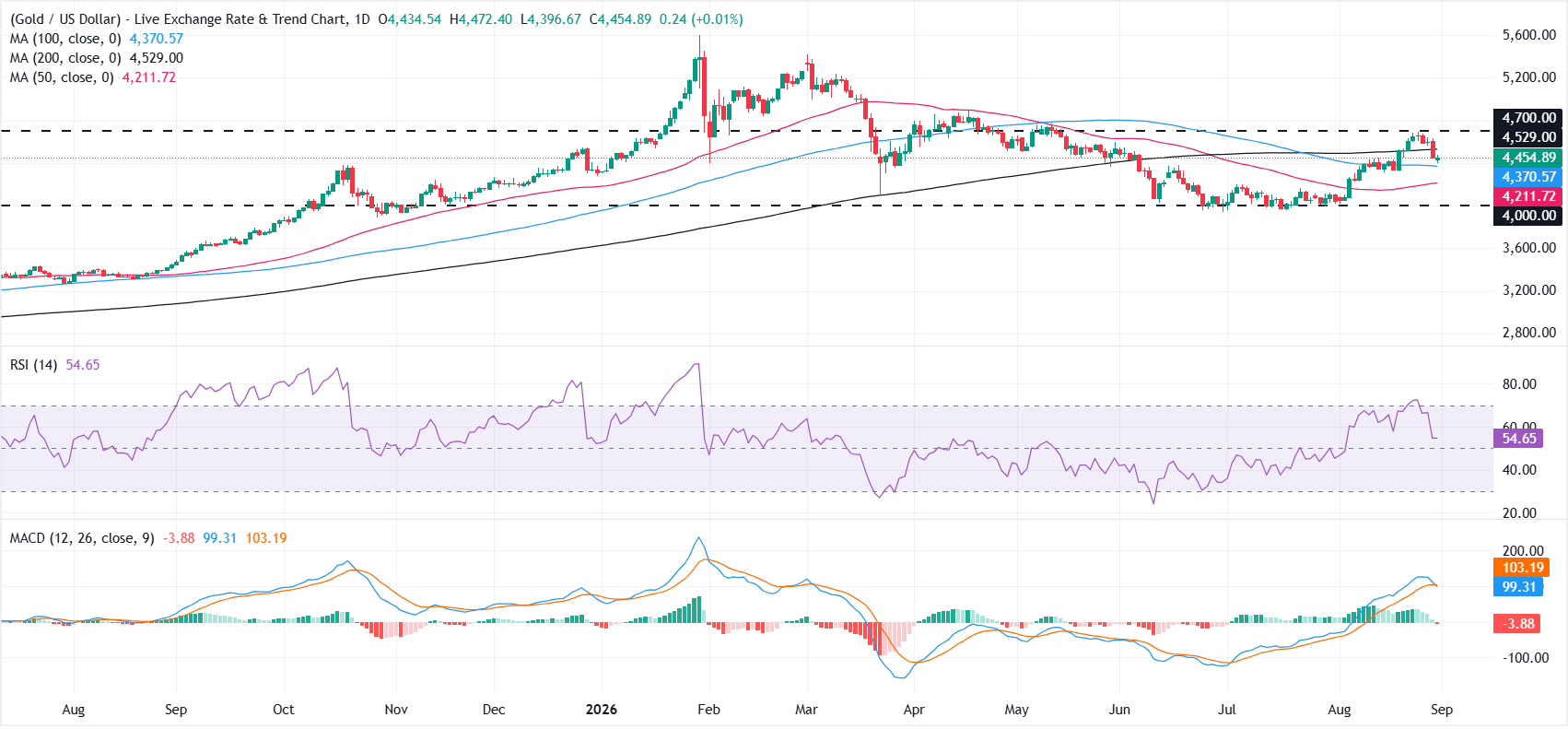
XAU/USD maintains a slightly bearish near-term bias following the latest leg lower, with the metal falling back below the 200-day Simple Moving Average (SMA) at $4,529. The Relative Strength Index (RSI) on the daily chart has eased from overbought territory to around 55, pointing to fading bullish momentum. Meanwhile, the Moving Average Convergence Divergence (MACD) has slipped marginally below its signal line, adding to signs of weakening upside pressure.
On the downside, initial support is located at the 100-day SMA at $4,370, followed by the 50-day SMA at $4,211. A sustained break below these levels could expose the horizontal floor near $4,000. On the upside, the 200-day SMA at $4,529 acts as immediate resistance, followed by the horizontal barrier at $4,700.
(The technical analysis of this story was written with the help of an AI tool. Know more.)
Gold FAQs
Gold has played a key role in human’s history as it has been widely used as a store of value and medium of exchange. Currently, apart from its shine and usage for jewelry, the precious metal is widely seen as a safe-haven asset, meaning that it is considered a good investment during turbulent times. Gold is also widely seen as a hedge against inflation and against depreciating currencies as it doesn’t rely on any specific issuer or government.
Central banks are the biggest Gold holders. In their aim to support their currencies in turbulent times, central banks tend to diversify their reserves and buy Gold to improve the perceived strength of the economy and the currency. High Gold reserves can be a source of trust for a country’s solvency. Central banks added 1,136 tonnes of Gold worth around $70 billion to their reserves in 2022, according to data from the World Gold Council. This is the highest yearly purchase since records began. Central banks from emerging economies such as China, India and Turkey are quickly increasing their Gold reserves.
Gold has an inverse correlation with the US Dollar and US Treasuries, which are both major reserve and safe-haven assets. When the Dollar depreciates, Gold tends to rise, enabling investors and central banks to diversify their assets in turbulent times. Gold is also inversely correlated with risk assets. A rally in the stock market tends to weaken Gold price, while sell-offs in riskier markets tend to favor the precious metal.
The price can move due to a wide range of factors. Geopolitical instability or fears of a deep recession can quickly make Gold price escalate due to its safe-haven status. As a yield-less asset, Gold tends to rise with lower interest rates, while higher cost of money usually weighs down on the yellow metal. Still, most moves depend on how the US Dollar (USD) behaves as the asset is priced in dollars (XAU/USD). A strong Dollar tends to keep the price of Gold controlled, whereas a weaker Dollar is likely to push Gold prices up.