Indonesian Rupiah gains ground as crude oil prices retreat
- Dropping oil prices eased imported inflation concerns, supporting the Indonesian Rupiah's recent rally.
- Bank Indonesia balances rate differentials with the US while managing a 3.19% inflation uptick.
- US Dollar struggles as lower oil yields pulled US Treasury rates back to 4.93%.
USD/IDR halts its six-day winning streak, trading around 17,780 during Asian hours on Friday. The currency pair continues to hold its losses, with the Indonesian Rupiah (IDR) drawing strength from a pullback in crude oil prices. Lower energy costs have helped ease fears of imported inflation across the region.
Crude prices tumbled following reports that Saudi Arabia is actively taking steps to restore flows through its crucial East-West pipeline. Additionally, market focus has turned toward upcoming discussions between US President Donald Trump and leaders in the Gulf region, offering hopes for stabilized regional supply chains.
Domestic conditions in Indonesia present a mixed picture. Local policymakers are working to contain food-price volatility following an acceleration in August's headline inflation rate to 3.19%. Despite these efforts, broader market sentiment remains constrained by an uncertain policy outlook.
Bank Indonesia (BI) faces the delicate balancing act of maintaining an effective interest-rate differential relative to the US while simultaneously upholding rupiah stability and supporting economic growth. Traders are now closely awaiting BI’s policy decision next week, which follows two consecutive months of unchanged borrowing costs in August.
On the US side of the pair, the US Dollar (USD) has encountered headwinds as falling oil prices help alleviate broad-based inflationary pressures. The retreat in inflation expectations pulled US Treasury yields lower from their recent multi-year highs, with the benchmark 10-year yield declining to approximately 4.93% after briefly surmounting the 5.0% threshold earlier in the week.
However, the Greenback’s downside potential may remain limited due to hawkish comments from Federal Reserve Chair Kevin Warsh. Warsh emphasized that inflation has stayed elevated for too long and noted that recent summer economic data did not demonstrate significant structural improvement. Following his remarks, market expectations shifted rapidly; the CME FedWatch tool now shows traders pricing in a 53.1% chance of a rate hike at the Federal Reserve's October meeting, up from 44% the previous day.
Fed’s Warsh underscores inflation fight, supports stronger Dollar tone
Warsh’s press conference registers a 7.4/10 on the FXS Speechtracker, modestly above the 7/10 historical average and signaling a firmer hawkish bias relative to the established baseline. The repeated emphasis that “today was the right decision,” grounded in an economy that has “strengthened” and allows the Fed to “focus on price stability,” frames the move as a deliberate withdrawal of accommodation driven by persistent inflation that is “not passing the test.” Warsh’s stress on trends over noisy data points and on staying “in our lane” on independence reinforces a disciplined, inflation-first stance that is supportive of a stronger Dollar narrative.
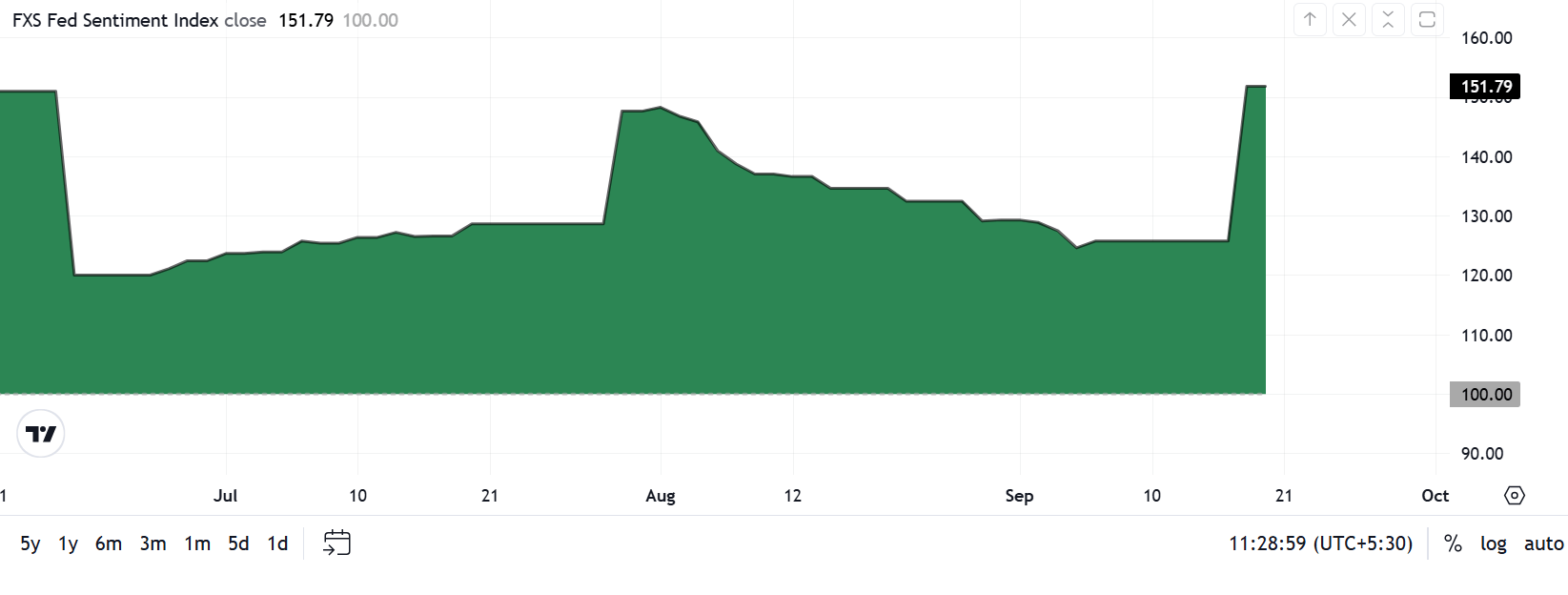
The FXS Fed Sentiment Index jumps by +26.07 points to 151.79, pushing deeper into hawkish territory well above the neutral 100 threshold and aligning with the above-baseline FXS Speechtracker score. This sizeable move confirms that markets are interpreting the decision and Warsh’s tone as a clear step toward tighter policy, with implications for higher Dollar yields and a more challenging backdrop for risk-sensitive currencies.